




Remote-Controlled, Supercharged Cancer Killers
Above: A time-lapse shows the Wang Lab’s EchoBack CAR T-cells attacking a large tumor mass. The green labeled points are the tumor cells. (Courtesy of Longwei Liu)
Imagine a cancer treatment that seeks out and destroys tumors with relentless precision, attacking cancers for days without tiring.
This isn’t science fiction; it’s the groundbreaking reality emerging from USC Viterbi’s labs. USC biomedical engineers have created a new immune cell, dubbed the “EchoBack CAR T-cell,” that could redefine how we fight stubborn solid tumors.
Traditional chimeric antigen receptor (CAR) T-cell therapy has been a game-changer for blood cancers like leukemia. It involves extracting a patient’s own T-cells, supercharging them in the lab to recognize and attack cancer, and then reinfusing them. However, solid tumors have remained a formidable challenge, often resistant to these therapies and difficult to target safely.
The latest breakthrough from the Wang Lab at USC’s Alfred E. Mann Department of Biomedical Engineering, published in the scientific journal Cell, tackles these hurdles head-on. The new EchoBack CAR T-cells don’t just attack; they launch a focused assault that lasts five times longer than previous iterations. Better still, these cells can be remotely activated and controlled using focused ultrasound, making treatments potentially safer and more effective.
A smarter, more persistent attack with the help of ultrasound

When we think of ultrasound, many of us imagine new parents eagerly looking at a screen during their pregnancy scans — the first ever images of their child forming before their eyes.
While pregnancy scans harness gentle, low-intensity sound waves to generate these images, focused ultrasound turns up the intensity of these waves to concentrate on a precise target. Lead study author Longwei Liu, an assistant professor at USC Viterbi, said that focused ultrasound was similar to using a magnifying glass to focus sunlight onto a small point.
“It generates heat exactly where it’s targeted, without affecting the surrounding area,” Liu said. “But unlike light, sound waves can penetrate deep into tissue, making them ideal for reaching internal tumors noninvasively, while we can tune the power and temperature it generated.”
This localized heat is then used to direct the cancer-fighting CAR T-cells to where they are needed.
“These cells are genetically engineered with a heat-sensitive ‘on switch,’” Liu said. “When focused ultrasound gently warms the tumor area just by a few degrees — not enough to harm tissue — this switch is flipped on. As a result, the CAR T-cells are activated only at the tumor site, allowing them to unleash their cancer-killing function with high precision and minimal side effects.”
Previous generations of ultrasound-controllable CAR T-cells typically only remained active for about 24 hours. This meant frequent hospital visits for patients. The EchoBack CAR T-cells are different. Activated by a short 10-minute pulse of ultrasound at the tumor site, they continuously seek and destroy cancer cells for at least five days.
“You can imagine that when patients come to the hospital using the first-generation cells, the patient may need to come in every day for treatment,” Liu said. “But using the new generation, the treatment now requires far fewer visits, such as once every two weeks, or even less frequently.”
“It’s definitely a breakthrough,” said Peter Yingxiao Wang, the Dwight C. and Hildagarde E. Baum Chair in Biomedical Engineering. “It will make the whole ultrasound-controllable CAR T practically useful for real medical applications.”
The ‘EchoBack’ advantage
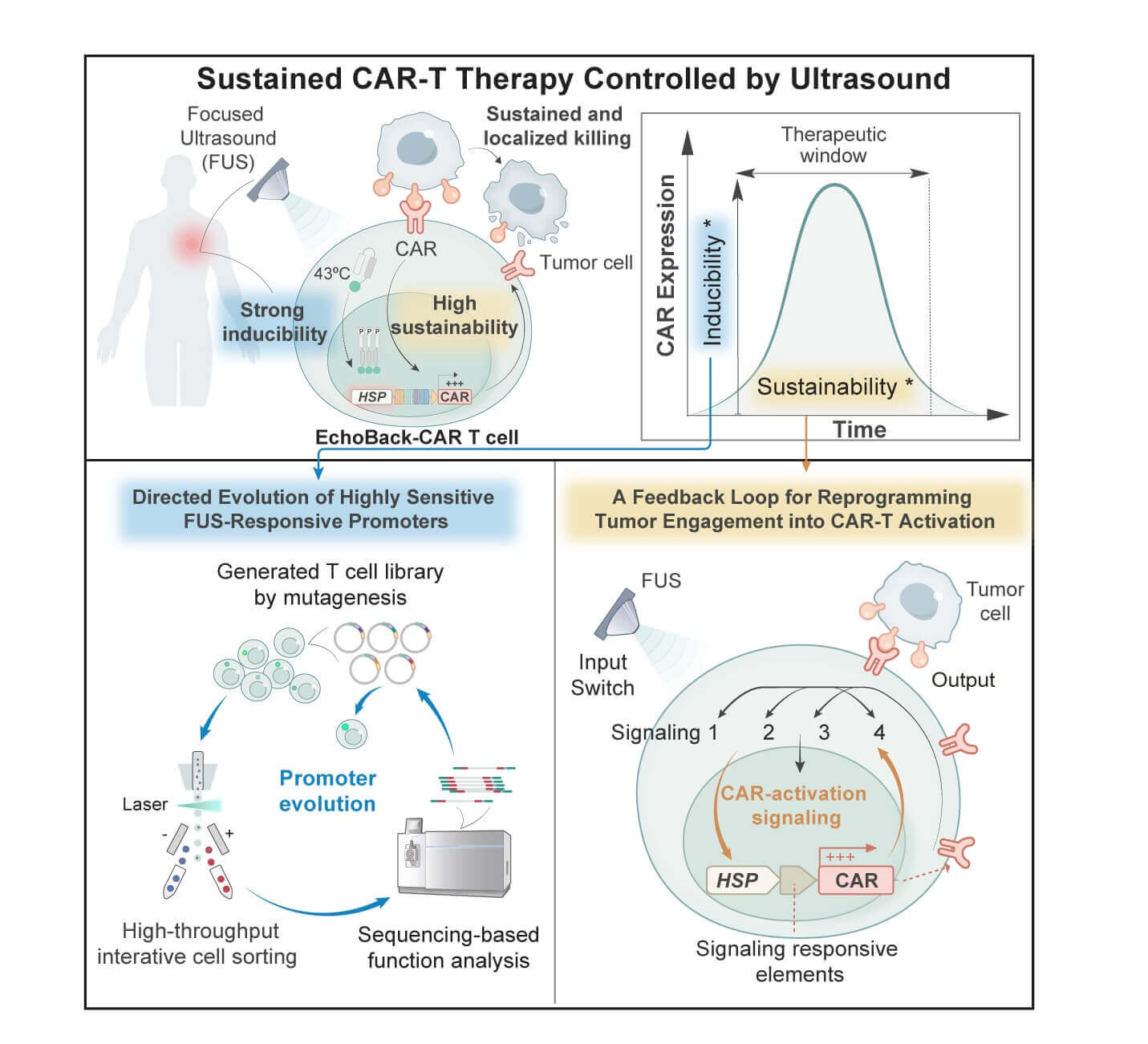
The secret behind these cells’ longevity lies in their unique EchoBack mechanism. They’ve been engineered with a clever call-and-response feedback loop that allows them to continuously react to the presence of tumor cells. When a tumor cell is nearby, it sends a signal to the EchoBack CAR T-cell, prompting the cell to produce more “killing molecules” to eliminate it. Imagine the supercharged immune cells like a pack of hunting dogs chasing a fox through the forest. The scared fox emits a scent — a signal that the dogs can recognize. In this case, Liu said, the CAR T-cells behave like highly trained hounds that are “not only sharp-nosed, but also able to hear over long distances, and think like humans.”
This built-in intelligence is also safer for patients. “Whenever there is a tumor cell nearby, the tumor cell sends a signal to our CAR T-cell, which will then produce more killing molecules to kill those tumor cells,” Liu explained. “That’s also why it’s safe. Because when those CAR T-cells migrate out of the tumor, the CAR molecule will gradually degrade, so they won’t kill the normal tissue. We’ve engineered them to be smart CAR T-cells.”
Promising results for future treatments
Laboratory experiments in mouse models that tested the EchoBack CAR T-cells against various tumor cells, including prostate cancer and glioblastoma, have shown remarkable promise. The results clearly demonstrated that the ultrasound-controlled CAR T-cells, with just two rounds of ultrasound stimulation, significantly outperformed standard CAR T-cells.
“We can clearly see that the ultrasound-controllable CAR plus two rounds of ultrasound stimulation outperformed the standard CAR T-cells,” Liu said. “Also, when we kept challenging our CAR T-cells with tumor cells, the standard CAR was already exhausted and in a dysfunctional state. But our ultrasound-controllable CAR has a better function, less exhaustion and more enhanced killing.”
USC Viterbi Ph.D. students Peixiang He and Yuxuan Wang contributed significantly to the project. The research team worked in close collaboration with colleagues in Yale University’s Department of Biomedical Engineering and the University of North Carolina at Chapel Hill on single-cell sequencing for the study. Qifa Zhou, USC’s Zohrab A. Kaprielian Fellow in Engineering, also provided insight into the ultrasound technology used for the development of the cells.
This breakthrough represents a significant stride toward more powerful, precise and patient-friendly cancer treatments. The research team now hopes this modular technology can be adapted to treat other solid tumors, such as breast cancer and retinoblastoma, offering new hope to countless patients.
Liu said that the EchoBack CAR-T cells are not just an idea — they are a real step toward the future of safe and efficient immunotherapy, offering new hope to patients with difficult-to-treat tumors.
“The most exciting part is that the CAR T-cells are smart,” Liu said. “They can listen to the ultrasound and sense the tumor cells. These types of CAR T-cells have never been developed previously, and we are looking forward to their benefits for patients in the future.”